Things To Do In Washington DC At Night: The Free Guide
Washington DC after dark is mostly free: the monuments stay open around the clock, several venues run evening programs that cost nothing, and two of the city's three pay-what-you-want walking tours start at sunset. Here is what is genuinely free, what needs a pass, and how to plan the evening.
Short answer
The monuments and memorials on the National Mall are free and open 24 hours a day, and they are the core of any free night in DC. Add the Kennedy Center's free Millennium Stage performances, the U.S. Botanic Garden's seasonal evening hours, and a pay-what-you-want moonlight walking tour rated 4.26 across 65 GuruWalk reviews.
What Is Actually Free To Do In Washington DC At Night?
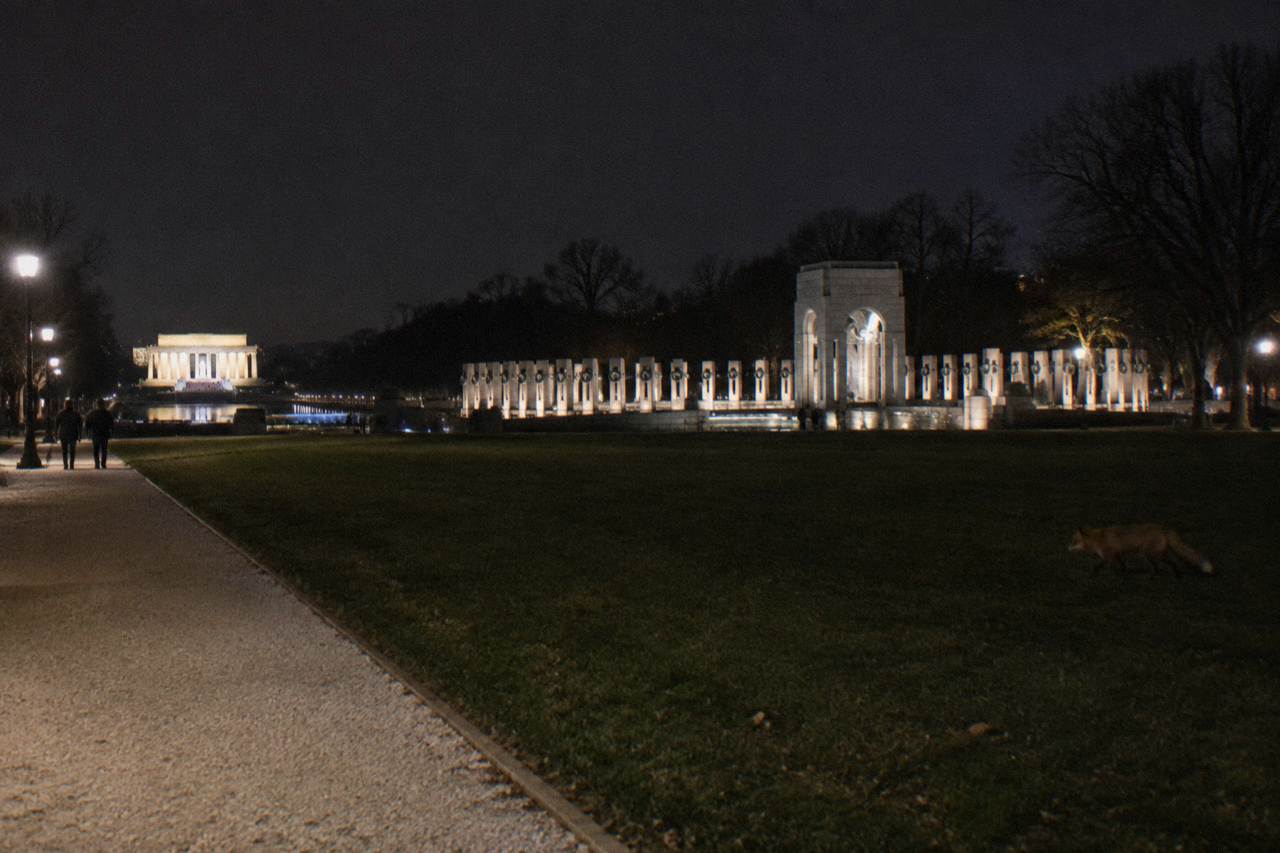
Most of DC's best night activity costs nothing. The Lincoln Memorial, the World War II Memorial, the Vietnam Veterans Memorial and the rest of the National Mall's memorials are free and open 24 hours a day, and the National Park Service keeps them lit and staffed overnight. Add free evening performances at the Kennedy Center, seasonal late hours at the U.S. Botanic Garden, and three pay-what-you-want walking tours.
The scale of the free offering is unusual among American cities. The Smithsonian Institution alone runs 20 museums plus the National Zoo, per the institution's own museum listing, and while most of those close by early evening, the outdoor landscape they sit in never does. Destination DC counted a record 27.2 million visitors in 2025 and a record 11.9 billion dollars in visitor spending, and a large share of those visitors spend their evenings on ground that charges no admission, which is why a full evening out can genuinely cost zero dollars.
The catch is that "free" in DC is not always unconditional. A handful of sites attach strings: the Washington Monument's grounds are free but going up requires a timed ticket, and some Smithsonian museums require a free timed-entry pass even during the day. This guide keeps those conditions attached to the claims rather than hiding them in a footnote, because the difference between walking in and being turned away at 7 p.m. is the whole evening.
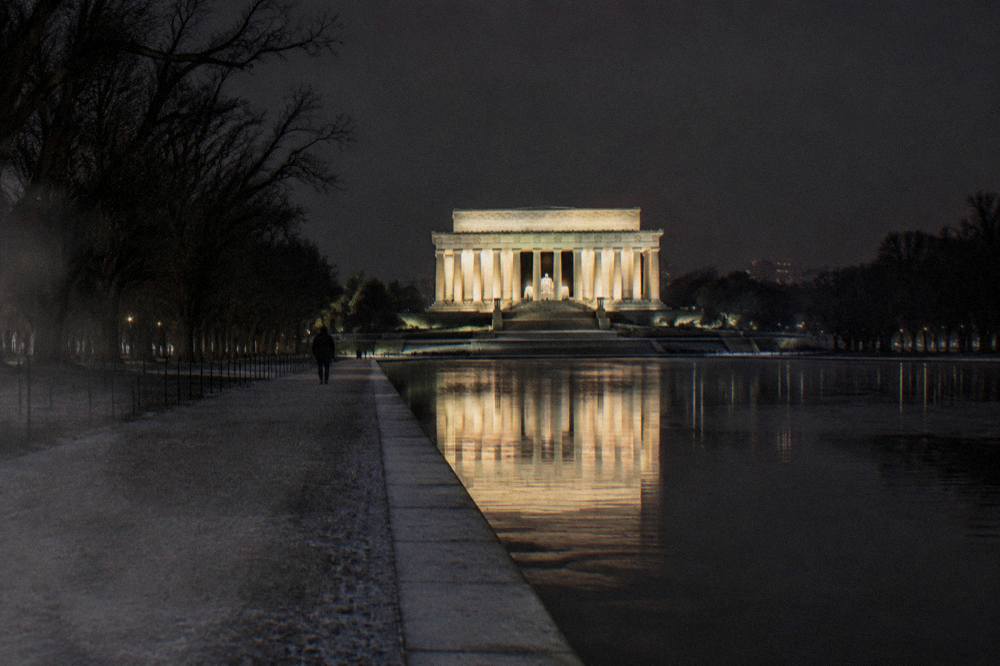
The other thing worth knowing is that night is arguably the better time to see the Mall. Daytime crowds at the Lincoln Memorial can be heavy; at 9 p.m. the steps quiet down, the floodlights turn the marble warm, and the Reflecting Pool doubles the view. Several of the city's free tours were built around exactly that fact.
Which Monuments And Memorials Are Best After Dark?
The Lincoln Memorial, the World War II Memorial, the Korean War Veterans Memorial and the Martin Luther King Jr. Memorial are the strongest night visits, and all four are free with no pass, no ticket and no closing time. The Mall's memorials are open 24 hours and lit overnight. The Vietnam Veterans Memorial is a particular night experience: the polished wall reflects the floodlights, and rangers staff it around the clock.
The western half of the Mall is the natural night circuit. Start at the World War II Memorial, where the fountain is lit and the pillars ring the pool, then walk west along the Reflecting Pool to the Lincoln Memorial. The view back east from Lincoln's steps, with the Washington Monument's lights and the Capitol dome in the distance, is the single most photographed free scene in the city after dark. From there, the Korean War Veterans Memorial and the Vietnam Veterans Memorial sit a short walk north, the wall mirroring both the floodlights and the surrounding trees, and the MLK Jr. Memorial and FDR Memorial sit along the Tidal Basin to the south.
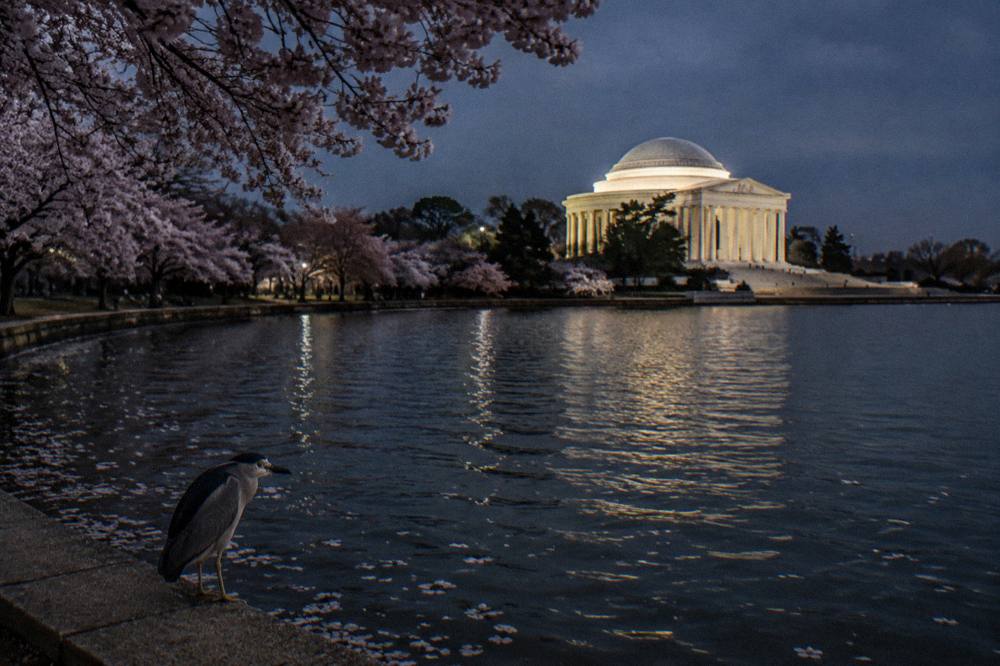
Two practical notes make the circuit work. First, the memorials are genuinely open: there is no gate, no ticket booth and no closing announcement, the National Park Service keeps the lights on overnight, and park rangers rotate through the grounds. Second, the Jefferson Memorial across the Tidal Basin is worth the extra fifteen minutes if the cherry trees are in bloom, since the NPS's Bloom Watch put peak bloom at March 26 in 2026 and the trees hold their petals for roughly a week.
The moonlight tour that covers this exact corridor is worth knowing about before you plan the walk yourself. Monuments By Moonlight is a pay-what-you-want evening walk run by guide Lisa on GuruWalk, rated 4.26 across 65 GuruWalk reviews, lasting an hour and a half and meeting at the Albert Einstein Statue. It runs through the West Mall corridor that includes the World War II Memorial and the Lincoln Memorial, so the ground it covers is the same ground described above, with the difference that a guide is telling you what you are looking at.
If you would rather compare the options before deciding, the three pay-what-you-want walks on this site's roster cover different angles of the same free landscape.
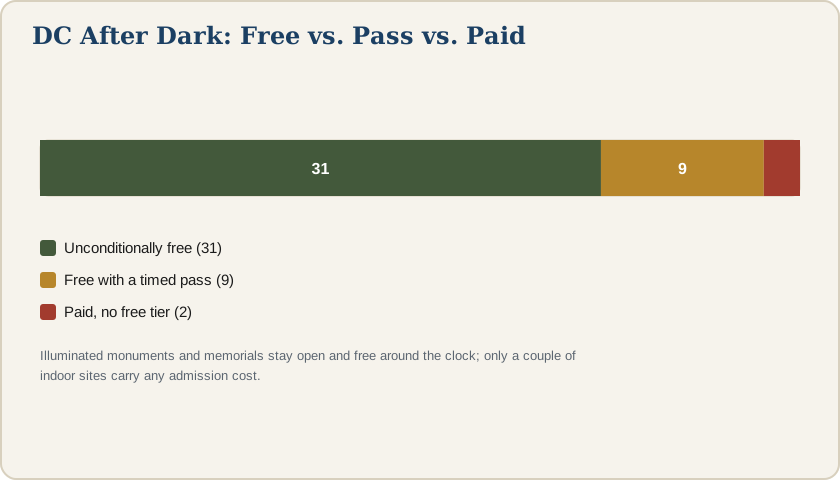
The table below is the short list for a first night circuit, with the honest condition attached to each stop.
| Memorial | Cost | Hours | Night notes |
|---|---|---|---|
| Lincoln Memorial | Free, no pass | Open 24 hours | Floodlit; steps face the lit Washington Monument |
| World War II Memorial | Free, no pass | Open 24 hours | Fountain lit at night; central Mall access |
| Vietnam Veterans Memorial | Free, no pass | Open 24 hours | Wall reflects lights; rangers on site overnight |
| Korean War Veterans Memorial | Free, no pass | Open 24 hours | Sculptures are dramatically lit after dark |
| Martin Luther King Jr. Memorial | Free, no pass | Open 24 hours | Sits on the Tidal Basin, quieter at night |
| Jefferson Memorial | Free, no pass | Open 24 hours | Best combined with cherry blossom season |
| Washington Monument grounds | Free | Open 24 hours | Ascent requires a timed ticket, not the grounds |
For a deeper look at the daytime version of this ground, the guide to free monuments on the National Mall covers each memorial's history and layout, and the question is the National Mall free? answers the access basics in one page.
Are Any Of DC's Museums And Attractions Open In The Evening?
Most Smithsonian museums close between 5 and 7:30 p.m., so the classic museum night is limited but not zero. The Kennedy Center's Millennium Stage programs are free, and the U.S. Botanic Garden runs seasonal evening hours with no admission charge. The museums that require a free timed pass by day, including NMAAHC and the Air and Space Museum, offer no evening entry.
The pattern is consistent: the free indoor attractions are daytime attractions. The Smithsonian's official museum list shows standard closing times in the late afternoon or early evening across the institution's DC venues, and no regular free night exists across the Mall museums. Ticketed sites follow the same clock: the Bureau of Engraving and Printing and similar reservation-only stops simply stop running tours at night. The National Gallery of Art has historically run occasional evening programs, but those are event-specific rather than standing hours, so check the gallery's own calendar rather than assuming.
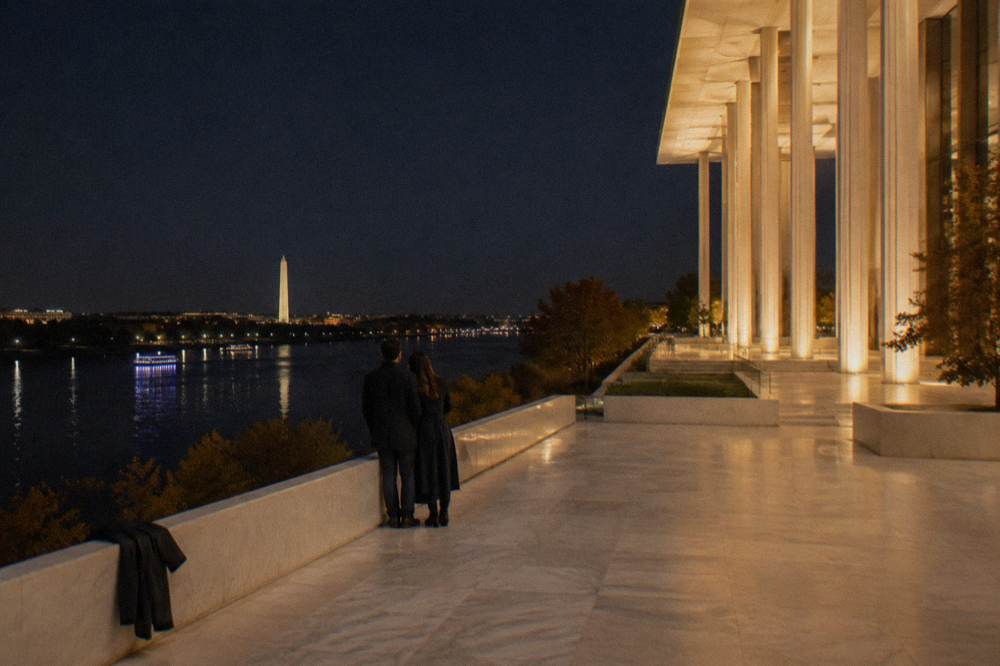
The two exceptions that matter for a free evening plan are both worth building around. The Kennedy Center's Millennium Stage has long run free performances, and the building itself is open in the evening with river terraces that look over the Potomac, so even without a show the visit costs nothing. The U.S. Botanic Garden, which is free during the day, is the other: its seasonal displays sometimes extend hours into the evening, and its conservatory on the Mall's southeast corner is an easy add-on to a monument walk.
One conditional-free fact belongs here because it trips people up at dusk: the Washington Monument's grounds are free and open around the clock, but going up requires a timed ticket. Same-day tickets are free at the Washington Monument Lodge, which opens around 8:45 a.m., while advance reservations through the National Park Service carry a 1 dollar non-refundable service fee per ticket. The Monument does not run elevator trips at night regardless, so this is a daytime errand that supports the nighttime view rather than a night activity itself.
| Attraction | Daytime cost | Evening status | Condition to know |
|---|---|---|---|
| Kennedy Center Millennium Stage | Free | Free evening performances | Program schedule varies; check the center's calendar |
| U.S. Botanic Garden | Free | Seasonal evening hours only | Hours change by season, confirm before going |
| Smithsonian museums (most) | Free, walk in | Closed by 5-7:30 p.m. | No standing free museum night on the Mall |
| NMAAHC | Free, timed pass required | Closed evenings | Passes via tickets.si.edu, up to 30 days ahead |
| Air and Space Museum DC building | Free, timed pass required | Closed evenings | Pass rule applies even though it is Smithsonian |
| Museum of the Bible | $34.99 adult, free Tuesdays through May 18, 2027 | Evening entry only on free Tuesdays | The free day is the exception, not the rule |
| Washington Monument ascent | Free same-day, $1 service fee in advance | No evening trips | Ticket needed even during the day |
The NMAAHC pass rule is the one that surprises visitors most, and the museum's own visit page is the source for current pass release times. The broader guide to free museums in Washington DC covers the daytime versions of all of these in detail.
If the evening's centerpiece is the outdoor Mall rather than an indoor program, the moonlight walk is the natural fit.
How Do You Turn A Free Day Walk Into A Night Walk?
The two-visit strategy works well in DC: see the monuments in daylight on the Daytime Monuments Walk, a pay-what-you-want tour rated 4.4 across 324 GuruWalk reviews that meets at the World War II Memorial, then return to the same ground after dark on your own or on the moonlight walk. At night the memorials read as different places, lit and quiet rather than crowded.
The daytime walk is the orientation pass. Guide Lisa's two-hour Daytime Monuments Walk on GuruWalk covers the West Mall corridor when the details are visible: the state names on the World War II Memorial's pillars, the engraving on the Vietnam wall, the inscriptions at the Lincoln Memorial. Meeting at the World War II Memorial puts the start in the middle of the night circuit described above, which makes the evening return easy to navigate from memory.
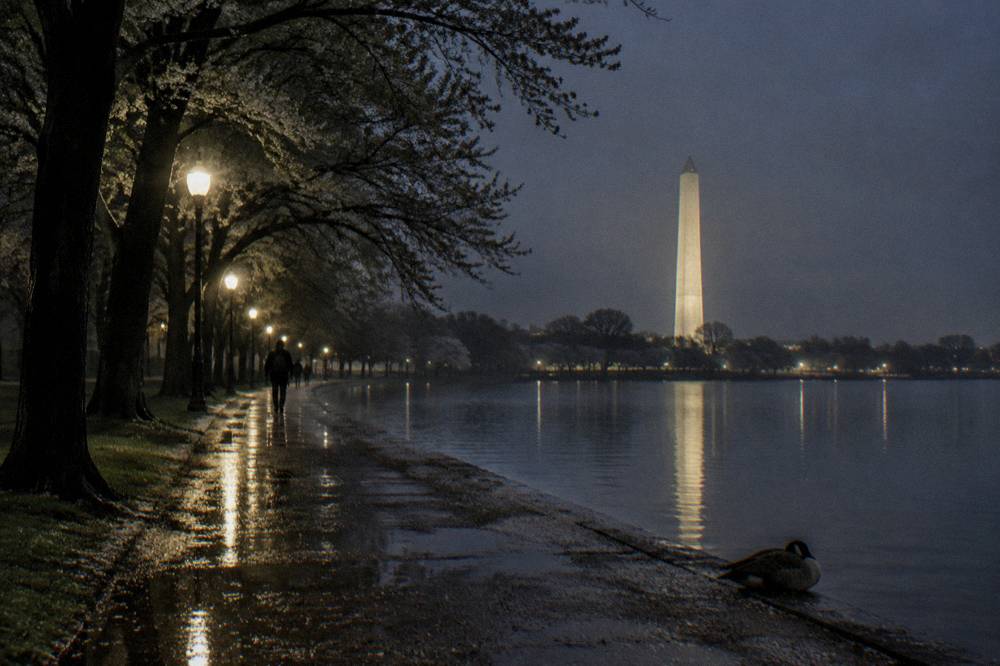
The night return is where the free part compounds. Everything the daytime tour showed you is still there, still free, and now lit, so the repeat visit is a feature rather than a redundancy. Many visitors do the daytime tour, eat dinner near the Mall or in the Penn Quarter, and then walk back west as the floodlights come on. The monuments are lit continuously overnight, so there is no single moment to catch, but the hour between full dark and about 10 p.m. balances light, safety in numbers and parking availability.
The pairing logic extends beyond the Mall, with one honesty rule: not everything pairs by geography. Georgetown, the National Cathedral, Arlington National Cemetery and the National Zoo are evening destinations in their own right, but none of them sits on the walking tours' route, so say "pair this with" rather than assuming the walk gets you there. Georgetown's waterfront is a short walk or bus ride west of the Kennedy Center, which makes it a natural after-show stop, and Arlington's entry is free during its open hours, though its grounds close at night.
Which Free Walking Tours Cover The Mall After Dark?
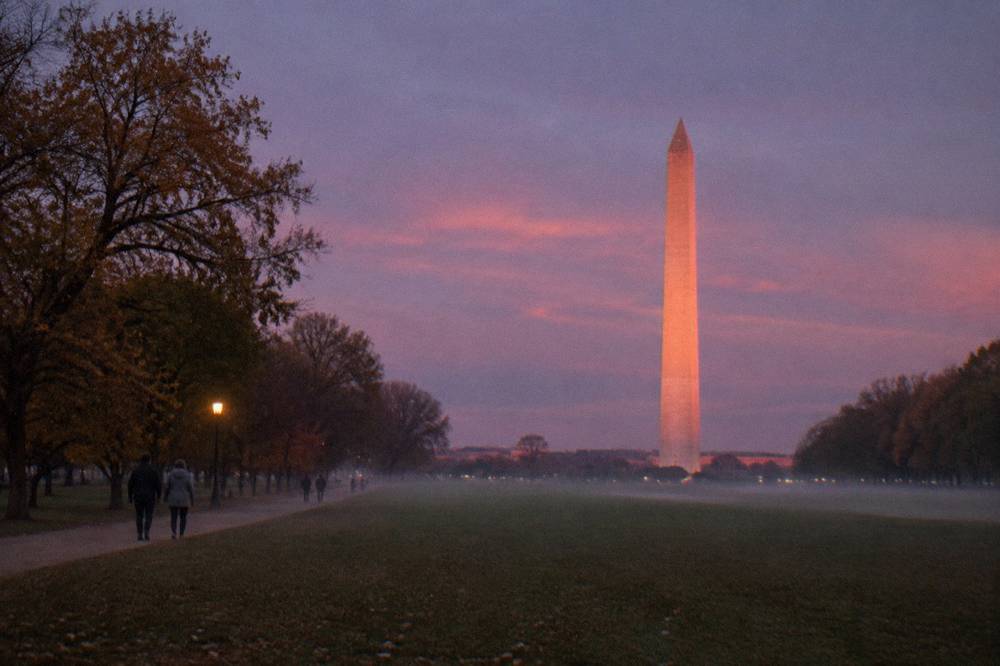
Two of the three walks on this site's roster run in the evening window. The Monuments By Moonlight walk on GuruWalk runs an hour and a half from the Albert Einstein Statue, and Blue Umbrella Tours' Mall walk on freetour.com runs two and a half hours, rated 8.7 out of 10 across 143 freetour.com reviews. The Daytime Monuments Walk is the daytime option.
The comparison is honest and simple, because the roster is small: this directory features exactly three walks, all free or pay what you want, and none of them carries a booking fee. The moonlight walk is the shortest and the most night-specific, built around the lit monuments. The Blue Umbrella Mall walk, listed as Free Tour The Mall Washington DC, is longer and broader, covering the Mall's full corridor at a slower pace, and it books through freetour.com rather than GuruWalk, which matters if you already have an account on one and not the other. A night plan uses one of the two evening walks; the daytime walk belongs to the daylight half of the two-visit strategy above.
What the walks share is the pay-what-you-want model. There is no price on any of the three listings, no minimum tip and no booking charge. The guide's income is the tip at the end, which is why the model is described honestly in the site's free walking tour tipping guide: the tour is free to reserve, and the payment is a judgment you make afterward. If a night out is being built on a strict zero-dollar budget, a self-guided monument walk costs nothing at all; the tours cost what you decide they were worth.
The Blue Umbrella walk's meeting point is on the Mall itself, and its two-and-a-half-hour length means it can serve as the whole evening's spine rather than one stop on it. The trade-off against the moonlight walk is pace and focus: longer and more general versus shorter and entirely after dark. Both are English-language walks, and both are reserve-first, since pay-what-you-want guides cap group sizes and a spot held is a spot counted.
Where Can You Find Free Evening Music, Theatre And Views?
The Kennedy Center is the anchor: its Millennium Stage has a long-running tradition of free performances, and the building's terraces are free to visit with a west-facing view over the Potomac at night. Beyond it, the free evening options are the city's outdoor spaces: the Southwest Waterfront's wharf promenade, the Mall's river-adjacent edges, and the monuments themselves, which cost nothing and are lit until dawn.
The Kennedy Center is the one indoor venue that consistently belongs on a free night list. It sits up the Potomac from the Lincoln Memorial, close enough that a monument circuit can end with a walk north along the river to the center's terraces. Even on nights without a Millennium Stage performance, the building is open, the views are free, and the rooftop terrace and river terrace are the quiet versions of the city's postcard views.
The outdoor list is longer than most visitors expect. The Southwest Waterfront's public promenade is free to walk and lit in the evening, with the river on one side and the city's newest skyline behind you. Meridian Hill Park, in the Columbia Heights neighborhood well north of the Mall, is a free public park whose cascading fountain and terraces make it a local evening hangout in warm months. Neither is on any walking tour's route, so both are pairings rather than stops, reachable by a short Metro or bus ride from the Mall.
A seasonal note belongs here rather than buried in a table: cherry blossom season turns the Tidal Basin into the city's best free night view, and the peak bloom date matters because the window is roughly a week. The National Park Service's Bloom Watch, the same source that tracks the Tidal Basin trees, put 2026's peak at March 26. Night walks around the basin during that week are the closest thing DC has to a free festival that requires no ticket.
| Free evening option | Neighborhood | What it costs | Best pairing |
|---|---|---|---|
| Kennedy Center terraces and Millennium Stage | Foggy Bottom / waterfront | Free | After a West Mall monument walk |
| Southwest Waterfront promenade | Southwest | Free | After dinner near the wharf |
| Meridian Hill Park fountains | Columbia Heights | Free | Standalone evening, not Mall-adjacent |
| Tidal Basin loop at night | National Mall | Free | Cherry blossom season, roughly a week in late March or early April |
| Georgetown waterfront | Georgetown | Free | After a Kennedy Center show, short ride north |
Is It Safe And Easy To Get Around DC At Night?
Yes, with the usual city caveats. The National Mall's monument core is patrolled by park rangers and U.S. Park Police around the clock, and it is the safest-feeling large public space in the city at night because it is lit and consistently busy until late. Metro runs until around midnight on weeknights, so the practical plan is to finish monument walking before the last train, and the standard big-city rules apply on quieter blocks beyond the core.
The Mall itself is the easy case. The memorial corridor is floodlit, the paths are wide and open, and visitor traffic continues well past 10 p.m. in most seasons. The Park Police presence is visible rather than theoretical. The edges of the plan are where the normal judgment kicks in: the walk between the Mall and some Metro stations passes quieter federal blocks, and neighborhoods north of downtown follow ordinary city rules after dark rather than the Mall's protected-bubble feel.
Transit is the main planning constraint. The Metro system's trains stop running around midnight on weeknights, later on Fridays and Saturdays, so a monument walk that starts at 9 p.m. has a comfortable window but not an unlimited one. The Smithsonian and Federal Triangle stations serve the Mall's center, and Foggy Bottom serves the western end near the Kennedy Center. Rideshare is the fallback, and parking on the Mall is free in some areas where posted, though it fills early and the National Zoo's lots are a different, paid story during the day.
| Planning item | The honest rule | What it means for the evening |
|---|---|---|
| Monument hours | Open 24 hours, free, lit overnight | No time pressure, but bring a layer |
| Metro close | Around midnight weeknights, later Fri-Sat | Start the walk by 9 p.m. for a relaxed pace |
| Food near the Mall | Limited late options on the Mall itself | Eat before the walk or near the waterfront |
| Restrooms | Memorial restrooms have limited hours | Use facilities before evening starts |
| Weather | Wind off the river drops the temperature | The Tidal Basin end is colder than it looks |
| Group size at night | Pay-what-you-want walks still cap numbers | Reserve the moonlight walk ahead, not on arrival |
One last structural point, because it is the difference between a plan and a wish: the free night in DC is almost entirely an outdoor night. The museums are daytime, the passes are daytime, and the evening's value comes from ground that never closes. Build the night around one lit corridor, one free indoor stop like the Kennedy Center, and a realistic transit deadline, and the zero-dollar evening holds together. For a broader daytime counterpart to this page, the site's free things to do in Washington DC this weekend guide keeps the same honesty rules across the full week.
The whole directory behind this guide, Free Things To Do In Washington DC, is built on one principle: every free claim carries its condition in the same sentence, and every walk is named with its platform and its real rating so you can check it yourself.
Common Questions About Free Things To Do In Washington DC At Night
What is free to do in Washington DC at night?
The National Mall's monuments and memorials are free and open 24 hours a day, and they are the core of a free night: the Lincoln Memorial, the World War II Memorial, the Vietnam Veterans Memorial, the Korean War Veterans Memorial, the MLK Jr. Memorial and the Jefferson Memorial all cost nothing and stay lit overnight. Add the Kennedy Center's free Millennium Stage performances and the Southwest Waterfront promenade, and a full evening can cost zero dollars.
Is the National Mall open at night?
Yes. The National Mall and its memorials are open 24 hours a day with no ticket or pass required for the grounds. The Washington Monument's grounds are also free at night, though going up the Monument requires a timed ticket and does not run in the evening regardless.
Are DC museums free at night?
Generally no. Most Smithsonian museums close between 5 and 7:30 p.m., and the ones that require a free timed pass by day, like NMAAHC and the Air and Space Museum's DC building, do not offer evening entry. The main free indoor evening option is the Kennedy Center, whose Millennium Stage programs are free and whose river terraces are open at night.
Is there a free night walking tour of the monuments?
Yes. Monuments By Moonlight is a pay-what-you-want evening walk run by guide Lisa on GuruWalk, rated 4.26 across 65 GuruWalk reviews. It lasts an hour and a half, meets at the Albert Einstein Statue, and covers the lit West Mall corridor. Reserving a spot is free, and you tip the guide at the end.
Is it safe to walk the monuments in DC at night?
The Mall's monument core is one of the safest-feeling large public spaces in the city after dark: it is floodlit, patrolled by the U.S. Park Police, and consistently busy with visitors until late. The standard big-city rules apply on quieter blocks beyond the core, and the main practical constraint is Metro, which stops around midnight on weeknights.
Do you have to pay for the free walking tours in DC?
No, and yes. All three walks on this site's roster are free to reserve with no booking fee and no minimum tip: the two GuruWalk walks and the freetour.com Mall walk. The guides work for tips, so the payment is a voluntary amount you decide at the end based on what the walk was worth to you.