Is The Kennedy Center Free To Visit?
Yes, the Kennedy Center is free to enter, and its Millennium Stage runs free live performances. Here is what is genuinely free there, what is not, and how to plan a visit.
Is The Kennedy Center Free To Visit?
Yes, the Kennedy Center is free to visit. Entry to the building costs nothing, and the Millennium Stage program stages free live performances, which is why the Kennedy Center Millennium Stage appears on this site's verified list of unconditionally free things to do in Washington DC. What costs money is the ticketed programming: the opera, the symphony, the theater productions, and touring shows inside the main halls.
The distinction matters more here than at most DC attractions, because the Kennedy Center is not a museum with a single front desk and a single price. It is a performing arts complex with multiple halls, a large riverside terrace, exhibit spaces, and a daily free-performance program running alongside a commercial ticketing operation. A visitor can spend an entire afternoon there without spending a dollar, or spend hundreds on a single evening, and both visitors walk through the same doors.
The free tier is real and it is structural, not a promotional afterthought. The Millennium Stage was created on the premise that every day of the year, somewhere in the building, a performance happens that anyone can walk in and watch without a ticket. That is the center's own founding promise for the free program, and it is the reason this building earns its place in a guide to free DC alongside the Smithsonian museums and the memorials.
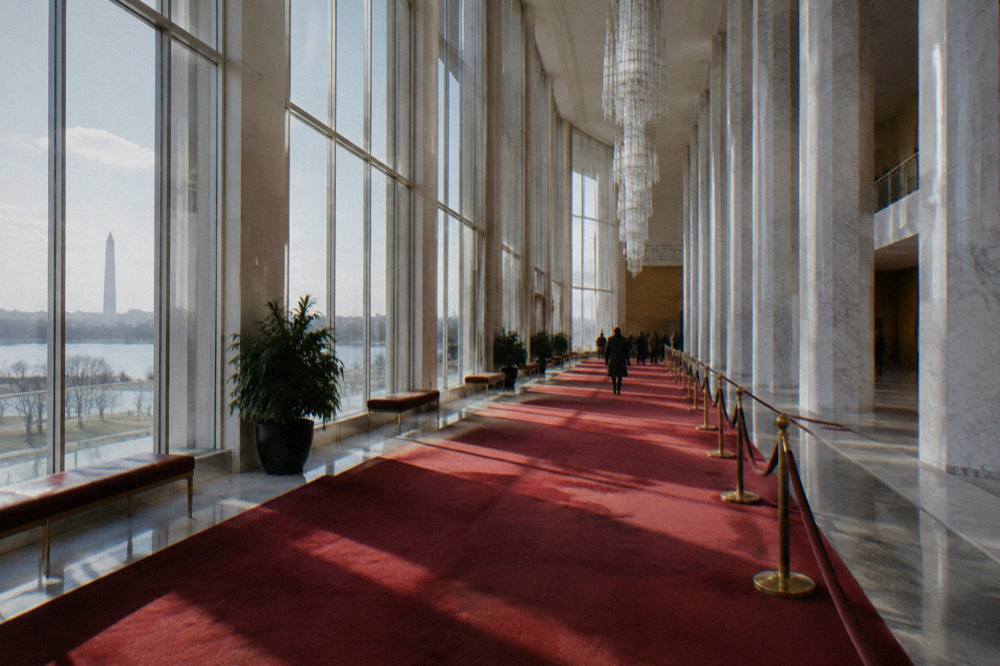
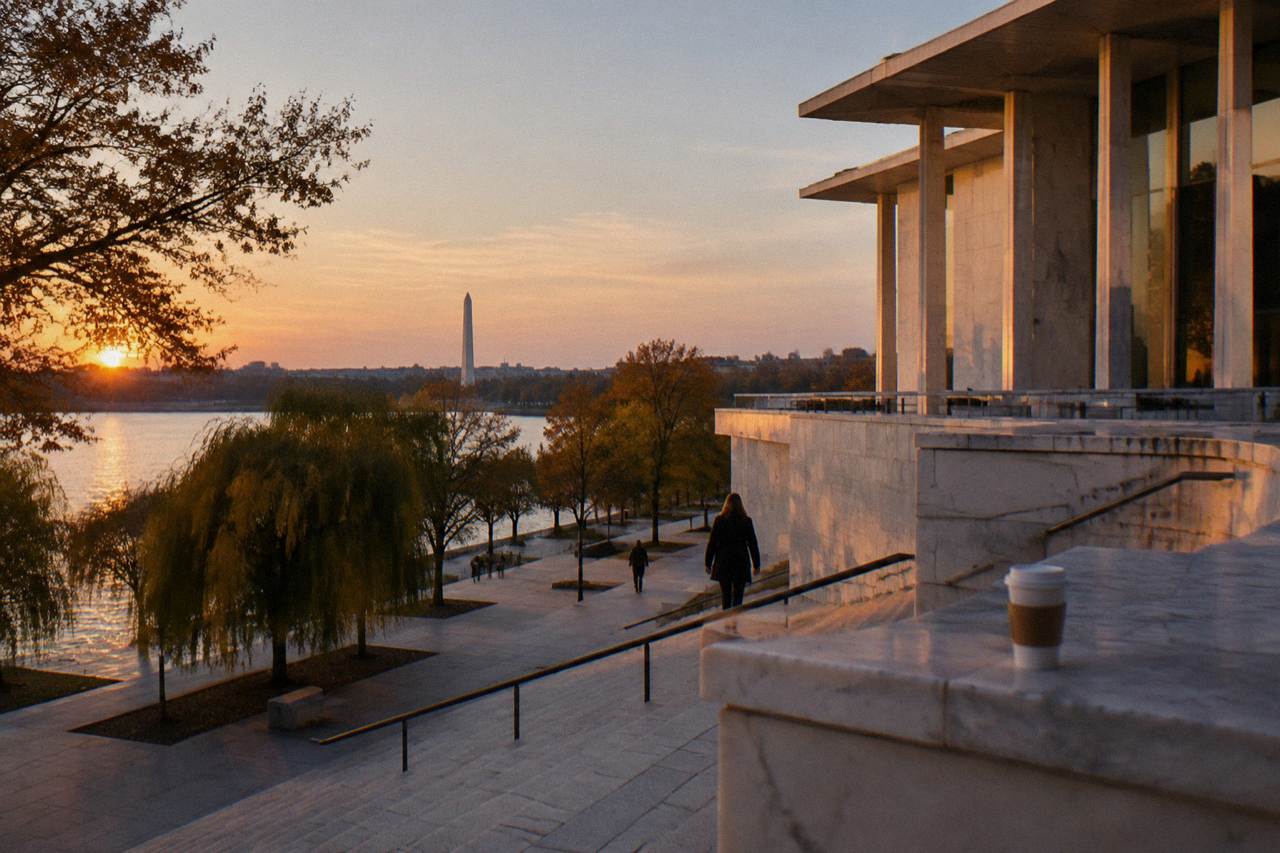
There is a second free layer people often miss: the building itself. The Grand Foyer is one of the longest rooms in the world, the rooftop terrace looks out over the Potomac River, and the halls display art and memorabilia connected to the center's namesake and its performance history. None of that requires a ticket. If your question is only "can I walk in?", the answer is yes, during opening hours, at no charge.
What the free entry does not include is a seat at a scheduled performance in the Eisenhower Theater, the Opera House, or the Concert Hall. Those are commercial events with box-office prices, and the gap between the free building and the paid show is where most visitor confusion lives. The rest of this article walks that boundary in detail: what is free, what the Millennium Stage actually is, how to get there, and how a free evening at the Kennedy Center pairs naturally with the free monument corridor two miles east.
It also helps to understand why the free tier exists at all, because the Kennedy Center occupies an unusual position among Washington's cultural institutions. It is a living memorial to President Kennedy, funded and governed as a national cultural institution rather than a purely commercial venue, and the free Millennium Stage program flows directly from that public mission. Where a private theater operator would price every seat, the Kennedy Center deliberately reserves a daily slot for free public access. That institutional design is why the free tier has survived for decades rather than appearing as a temporary promotion, and it is why a visitor can rely on it when planning a trip months ahead.
What Can You See At The Kennedy Center Without A Ticket?
Without a ticket you can enter the Grand Foyer, view the hall displays and artwork, visit the River and Roof Terrace levels when open, and attend a Millennium Stage performance for free. The box office, the gift shop, and the dining spaces are open to walk-in visitors too. Only the ticketed halls and paid tours sit behind the free line.
Start with the Grand Foyer, because it is the single most impressive free interior in the building. It runs the length of the main hall complex, hung with chandeliers and lined with the box-tier balconies of the Opera House and Concert Hall. It functions as a public room, not a ticketed one, and on performance evenings it fills with dressed-up crowds, which is part of the spectacle even if you are not staying for the show. During daytime hours it is quiet enough that you can walk its full length and read the memorial displays without obstruction.
The building also carries permanent and rotating exhibits that cost nothing to view. Displays connected to President Kennedy, to the center's construction, and to the performing companies that reside there are placed through the public areas. The Robert Berks sculpture of Kennedy in the Grand Foyer is the piece most visitors come looking for, a larger-than-life bronze head that anchors the room's west end. You do not need a ticket, a reservation, or a timed pass to stand in front of it.
| Space or activity | Free to walk-in visitors | Notes |
|---|---|---|
| Grand Foyer and public halls | Yes | Open during building hours, no pass needed |
| Millennium Stage performances | Yes | Free performances, no ticket required |
| Building exhibits and the Berks sculpture | Yes | Placed in public areas |
| River and Roof Terrace access | Yes, when open | Terrace hours can vary with private events |
| Concert Hall, Opera House, Eisenhower Theater shows | No | Box-office tickets, prices set per event |
| Dining and the gift shop | Open to all | You pay for what you buy, entry is free |
The River Terrace and the Roof Terrace deserve a specific mention, because they are the parts of the visit that feel least like a performing arts center and most like a free viewpoint. The terraces face the Potomac, and the Roof Terrace in particular gives an open-air panorama across the river toward Rosslyn and the Georgetown waterfront. Terrace access can be restricted when private events book the space, so treat the terraces as a free feature that is usually, not always, available. The building's own visit pages at kennedy-center.org carry the current access notes.
One honest caveat: the free building is at its best in the late afternoon and early evening, when the foyer lights are on and the pre-show crowd builds. A mid-morning visit can feel like touring an empty stadium, impressive in scale but hollow in atmosphere. If your only goal is the architecture and the view, time the visit for the last two hours of daylight and stay for the Millennium Stage performance afterward.
Photography is another free-layer detail worth knowing. The public halls and terraces are generally open to casual photography, which makes the building one of the better free photography stops on the west end of the Mall corridor: the chandeliers, the columns, the bronze sculpture, and the river view all sit inside the free zone. Visitors with professional equipment should check the center's own policies in advance, but a phone camera in the foyer is simply part of the free visit. On a clear evening the rooftop view of the Potomac at sunset is among the strongest free vistas in central DC, and it costs exactly nothing to stand there and take it in.
What Is The Millennium Stage And How Does Free Performance Work?
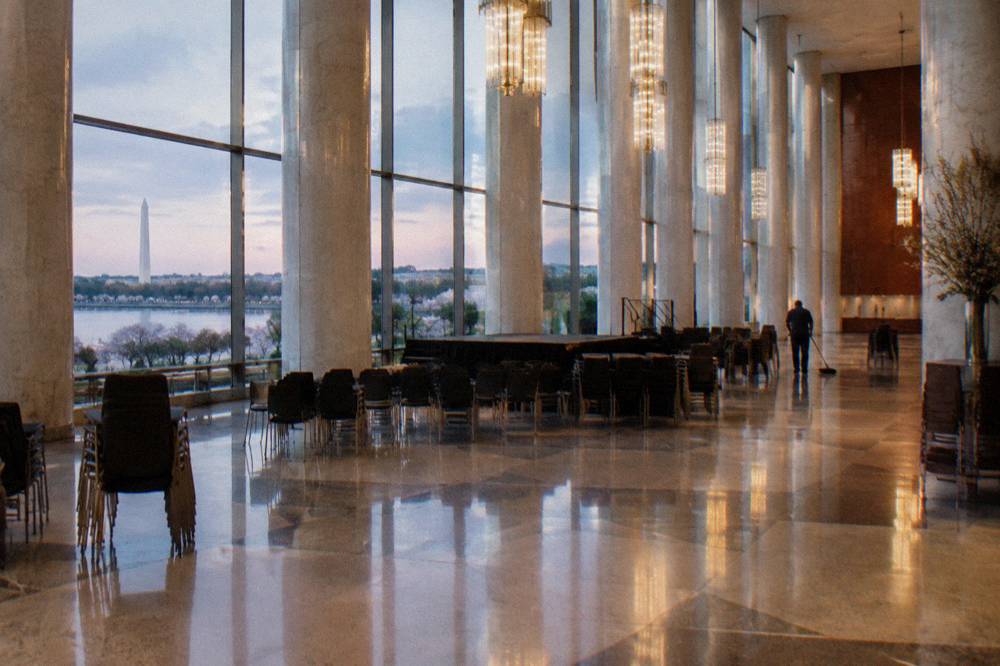
The Millennium Stage is the Kennedy Center's free daily performance program, staged in the Grand Foyer and open to anyone who walks in, no ticket, no reservation, no charge. It exists specifically to guarantee that the center offers a free live performance every day, and it is the flagship of the free tier.
The program's premise is simple enough that people sometimes assume there is a catch: a free concert or performance, most evenings at a set time, in the foyer space where the public already walks. There is no catch. The stage exists as a permanent institution, funded as part of the center's public mission, and the performers range from local jazz groups and student orchestras to touring acts and dancers. The performance schedule is published on the Kennedy Center's own site, and the practical planning advice is to check that day's listing before you go, because the genre varies completely from one evening to the next.
Arrival logistics are forgiving. Millennium Stage audiences gather in the foyer, seating is unreserved, and regulars typically arrive twenty to forty minutes ahead of the posted start time for a chair near the front. Late arrival usually still gets you a spot, standing or seated further back, since the foyer is large. The performance runs about an hour, which makes it a comfortable add-on to a DC evening rather than a full-night commitment.
The Millennium Stage is also the best free rainy-day or winter option on this stretch of the Mall corridor. The outdoor memorials do not stop being free in bad weather, but they stop being pleasant, and the Kennedy Center is one of the few major free indoor venues on the west end of the National Mall that requires no pass of any kind. The Smithsonian museums two miles east share the free-entry rule, but several of them now carry timed-pass requirements, a point covered in detail in is the Smithsonian free. The Millennium Stage carries none.
For visitors comparing free evening options, the Millennium Stage pairs naturally with the free monument corridor. The Kennedy Center sits on the Potomac riverfront just northwest of the Lincoln Memorial, across Rock Creek Parkway, and the monuments between the World War II Memorial and the Lincoln Memorial stay lit and open all night. A free 6 p.m. performance ends with the whole illuminated stretch still ahead of you, which is why this site's own evening walk recommendation belongs in the same plan. Monuments By Moonlight, Evening Walk is a pay-what-you-want walk on GuruWalk, rated 4.26 across 65 GuruWalk reviews, running 1 hour and 30 minutes from the Albert Einstein Statue. It covers the lit memorial corridor that the Kennedy Center's evening audience walks out into, and it is led by a guide named Lisa who also runs the daytime version.
The walk's meeting point is itself a free stop worth knowing: the Albert Einstein Memorial, a bronze figure on the National Academy of Sciences grounds near the Lincoln Memorial, is one of the 31 unconditionally free entries on this site's verified list. If you take the moonlight walk after a Millennium Stage performance, you are stacking three genuinely free experiences into one evening: the foyer, the performance, and the lit monuments, with the walk's cost decided entirely by what you choose to give at the end.
How Do You Get To The Kennedy Center?
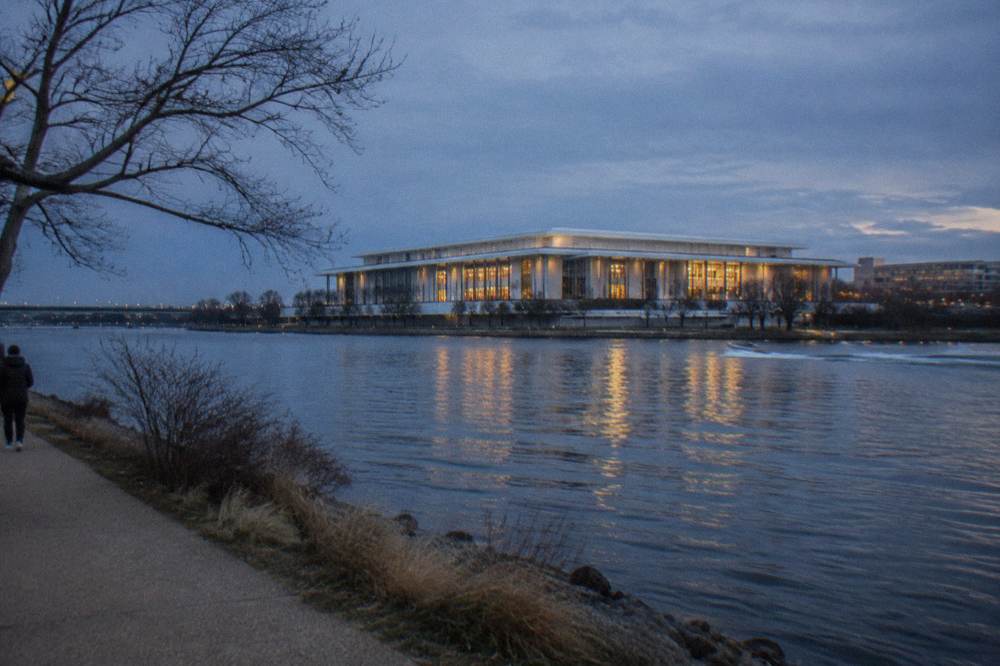
The Kennedy Center sits on the Potomac riverfront at the far west end of the National Mall. The nearest Metro stations are Foggy Bottom on the Blue, Orange, and Silver lines, about 10 to 12 minutes on foot, and Farragut West, farther out at roughly 20 to 25 minutes. There is no on-site free parking; garage parking is paid.
The walk from Foggy Bottom is flat and direct, running about half a mile through the George Washington University campus and past the State Department. It is the route most locals use, and it deposits you at the building's main entrance without any stairs or hills. From the National Mall itself, the center is a longer but simple walk west along Constitution Avenue and then down New Hampshire Avenue, roughly 30 minutes from the Lincoln Memorial, which places the building firmly inside a monument-day itinerary rather than off it. The rest of the planning pages sit on Free Things To Do In Washington DC.
The paid-parking point deserves emphasis because it is the one place a "free visit" quietly stops being free. The center's own garage charges by the hour, and street parking in Foggy Bottom is metered and scarce. This is the same pattern the National Zoo runs into: free admission, paid parking, which is covered in full in is the Smithsonian National Zoo free. The clean free route is Metro plus a walk, and on a pleasant evening that walk passes the Watergate complex and the Potomac edge, which is scenery worth having.
| Route | Cost | Time | Notes |
|---|---|---|---|
| Metro to Foggy Bottom, walk | Metro fare only | ~15 min walk | Blue, Orange, Silver lines |
| Walk from the Lincoln Memorial | Free | ~30 min | Flat, along the Mall's west axis |
| Car, center garage | Paid, hourly | Direct | No free on-site parking |
| Capital Bikeshare nearby | Rental fee | Varies | Stations in Foggy Bottom and on the Mall |
Cyclists and bikeshare users have it easy: stations sit in Foggy Bottom and along the Mall, and the riverside approach is one of the more pleasant rides in central DC. Drivers should treat the garage as the last resort and check the center's own visit page for current rates, since parking figures are exactly the kind of number this site does not quote without a verified source.
Accessibility on the approach is good, which matters for a free visit built around walking. The Foggy Bottom route is flat and sidewalked the whole way, and the center's entrances are designed for large evening crowds, so wheelchair and stroller access is part of the building's normal operation rather than a special arrangement. Families planning a free day should note that the same flat corridor continues east toward the monuments, which makes the Kennedy Center a realistic stop even on an itinerary built around small children and strollers, a combination this site explores in free things to do in Washington DC for families.
Is The Kennedy Center Free At Night?
Yes, and night is arguably the best time to go. The building stays open into the evening, the Millennium Stage performs in the early evening, and the rooftop terrace overlooks a lit Potomac. The paid halls run their shows at night too, but the free tier does not shut down when the curtain rises.
A free evening at the Kennedy Center follows a natural arc. Arrive before sunset, walk the Grand Foyer and the terraces while the light is still on the river, take a seat for the Millennium Stage performance, and step out afterward into a city whose monuments are illuminated and open around the clock. The Lincoln Memorial, the Vietnam Veterans Memorial, the Korean War Veterans Memorial, and the World War II Memorial are all free, unconditionally, at every hour, and they sit directly on the walk or short ride back toward the Mall.
That corridor is where the pay-what-you-want walking options earn their place in a Kennedy Center evening. The daytime equivalent, Walking Tour of DC Monuments on GuruWalk, rated 4.4 across 324 GuruWalk reviews and running 2 hours from the World War II Memorial, covers the same stretch in daylight for visitors who prefer the morning version. Both walks are free to join with tipping at your discretion, a model explained in full in how free walking tours work.
There is also a third walk in this site's small roster, run by a different operator: Blue Umbrella's Mall Walk, a pay-what-you-want tour listed on freetour.com, rated 8.7 out of 10 across 143 freetour.com reviews, running 2 hours and 30 minutes along the Mall. With only three walks in total on this site's roster, the honest framing is that these are three specific options rather than a shelf of dozens, and the moonlight walk is the one that matches a Kennedy Center evening best.
What Free Things Are Near The Kennedy Center?
The nearest free neighbors are the Watergate steps and the Potomac riverfront immediately outside, the National Mall's monument core a 30 minute walk east, and the Foggy Bottom campus streets between them. The Lincoln Memorial, the Vietnam Veterans Memorial, and the Albert Einstein Memorial are all within free walking range.
The immediate surroundings are underrated. The center sits at the edge of Rock Creek Parkway's green corridor on the Potomac, and the riverside path toward Georgetown is a free walk with the river on one side. Georgetown itself, a short walk north, is a free-to-wander neighborhood of shops and cobblestones, though its attractions are commercial; pairing the Kennedy Center with a Georgetown stroll is a classic free-visit combination, and this site's guide to free things to do in Washington DC for couples builds exactly that kind of evening.
East of the building, the free monument core begins. The World War II Memorial anchors the west end of the reflecting pool axis, and from there the Lincoln, the Vietnam, and the Korean War memorials cluster within a few hundred yards of one another. Every one of them is free and open around the clock, and the full set is mapped in free monuments and memorials on the National Mall. A visitor who spends the afternoon in that corridor and the evening at the Kennedy Center has assembled an entirely free day in the most-visited corner of the capital.
One caution for planners: do not assume the free-entry pattern here generalizes to the neighborhood's other institutions. The Kennedy Center charges nothing to walk in, but the conditionally-free rules elsewhere are institution-specific. The Washington Monument's grounds are free while its ascent needs a timed ticket, the National Museum of African American History and Culture requires a free timed pass despite being free, and the International Spy Museum across the city uses dynamic date-based pricing with no static figure published. The honest habit, and the one this site runs on, is to check each institution's own access rule rather than assuming a shared one.
For a fuller map of the free landscape, this site's guide to free things to do in Washington DC today collects the unconditionally free attractions in one place, and the Kennedy Center's free tier belongs on any list that also includes the National Gallery of Art, the National Archives Museum, and the Library of Congress. Each of those carries its own access rule, but none of them charges a base admission, and together with the Kennedy Center they form the backbone of a DC trip that costs nothing at the door.
Common Questions About The Kennedy Center
Is The Kennedy Center Free To Visit?
Yes. Entry to the building is free, the Grand Foyer, exhibits, and terraces are open to walk-in visitors at no charge, and the Millennium Stage stages free live performances. Only the ticketed shows in the main halls cost money.
Do you need a ticket for the Millennium Stage?
No. Millennium Stage performances are free and open to anyone who walks in, with unreserved seating. Regulars arrive twenty to forty minutes early for a chair near the front, but late arrival usually still gets you in.
Can you visit the Kennedy Center rooftop terrace for free?
Yes, when the terrace is open. The Roof Terrace and River Terrace are free public spaces with Potomac views, but access can be restricted when private events book them, so check the center's own visit page before counting on it.
Is parking at the Kennedy Center free?
No. The center's garage charges hourly rates and there is no free on-site parking. The clean free route is Metro to Foggy Bottom and a roughly 15 minute walk.
What free things are near the Kennedy Center?
The Potomac riverfront paths, the Watergate area, Georgetown's walkable streets, and the entire free monument core of the National Mall, including the Lincoln Memorial and the World War II Memorial, all sit within walking range.