Free Government Tours: Capitol, Library Of Congress And National Archives
Washington DC's three great government buildings, the Capitol, the Library of Congress and the National Archives, all let the public in without an admission charge. The catches are different for each, and this guide lays out exactly what is free, what needs a reservation, and how to stack all three into one trip.
Short answer
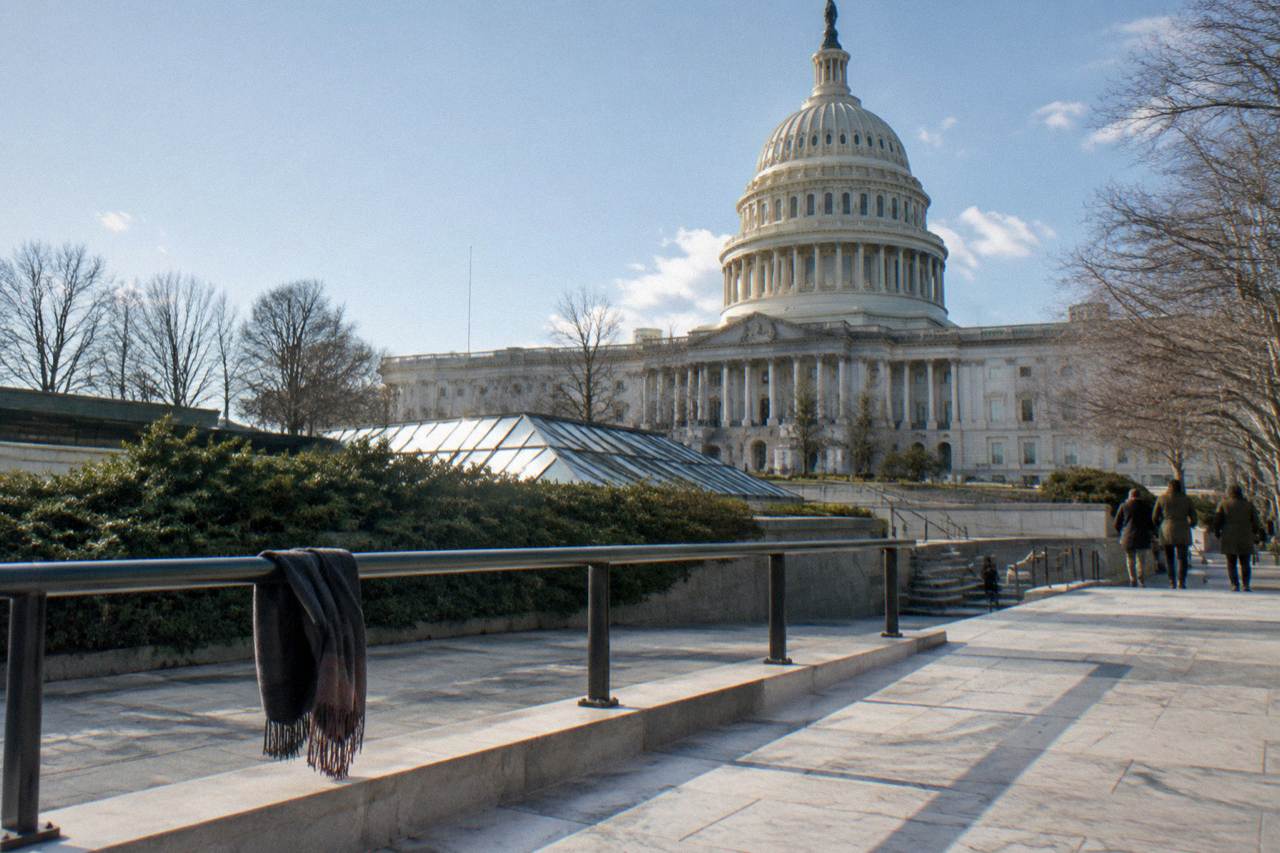
The US Capitol Visitor Center is free and open to the public, with free guided tours of the Capitol itself. The Library of Congress is free, and the National Archives Museum is free. All three sit within about a mile of each other, so a single day can cover the Capitol tour, the Archives' founding documents and the Library's Great Hall if you plan around each building's reservation rules.
Washington DC gives away more institutional grandeur per city block than almost any capital on earth. The three buildings that anchor the east end of the National Mall, the United States Capitol, the Library of Congress and the National Archives Museum, are all publicly funded, and all three admit visitors without an admission fee. The differences are in the fine print: one requires a tour reservation, one is genuinely walk-in, and one has hours so tight that a bad arrival time can cost you the visit.
This guide covers each building in turn, the exact free access rules, and how to sequence all three into a single day without paying a cent. It also explains how these government buildings connect to the monument corridor further west, where the free walking tours listed on Free Things To Do In Washington DC run, so the whole day, buildings and monuments alike, stays free.
Are The Capitol, Library Of Congress And National Archives Really Free?
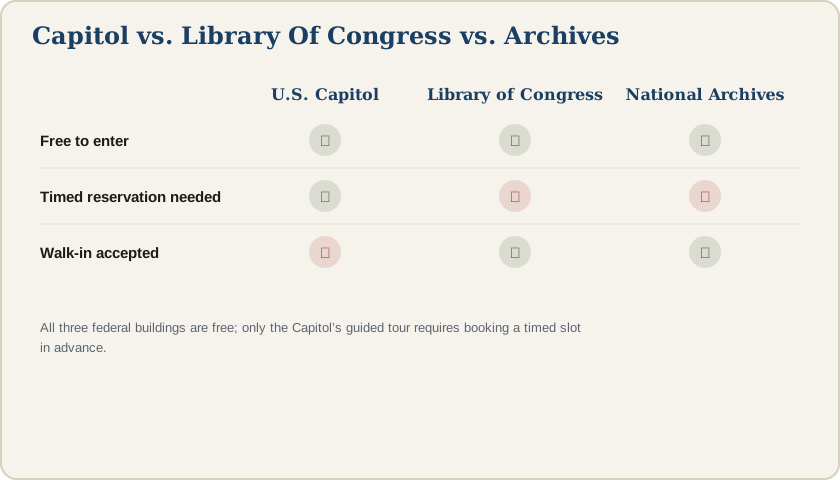
Yes, all three are genuinely free to enter: the Capitol requires a timed tour reservation, the Library of Congress needs no ticket for its main buildings, and the National Archives asks only that you pass through security screening, so plan ahead for the Capitol while the other two welcome walk-ins. The Capitol requires a free timed tour reservation for the guided tour of the building itself, though the Visitor Center galleries are open to walk-ins. The Library of Congress's Jefferson Building is free with no ticket at all. The National Archives Museum is free, but lines are longest in the middle of the day and its hours are the shortest of the three. None of the three charges admission, and none of the three is a Smithsonian museum, so the timed-pass systems used by NMAAHC or the Air and Space Museum do not apply here.
That last point matters more than it sounds. DC's free-attraction rules are building-specific, and generalizing one institution's reservation system onto its neighbors is the most common planning mistake in the city. The Smithsonian's walk-in reputation does not extend to two of its own museums, and the Capitol's tour-reservation rule has nothing to do with the Library of Congress next door, which wants no reservation from you at all. Treat each building on its own terms and the day runs smoothly.
The other thing worth knowing up front is geography. The Capitol Visitor Center sits under the east plaza of the Capitol itself. The Library of Congress's Jefferson Building is directly across First Street, a two-minute walk. The National Archives is a fifteen-minute walk west along Constitution Avenue, on the edge of the Mall's monument corridor. That tight triangle is what makes a free three-building day physically possible.
United States Capitol Visitor Center: What A Free Visit Includes
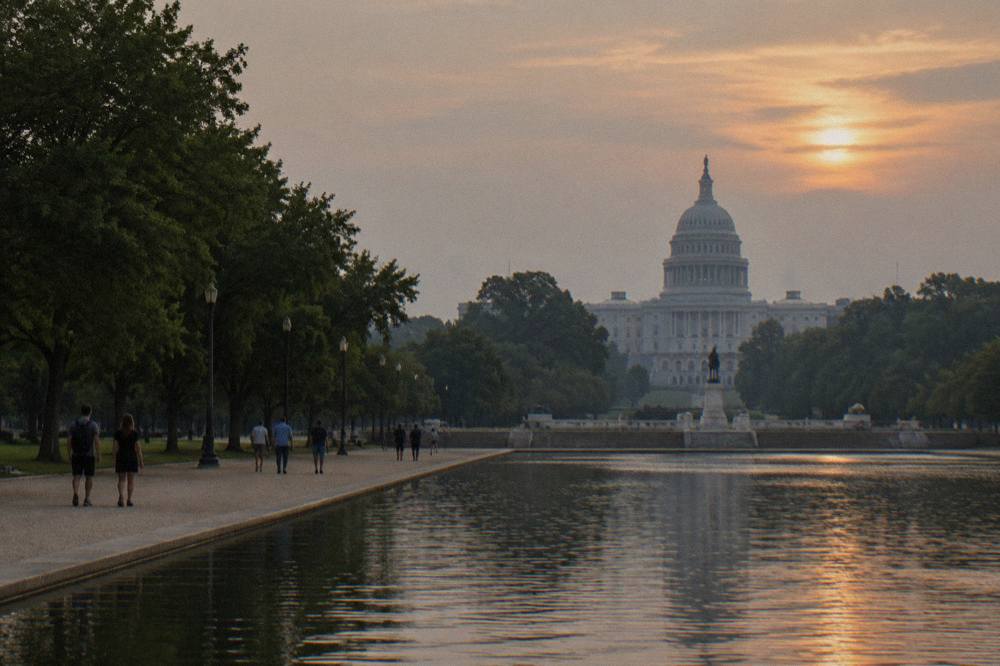
A free visit to the United States Capitol Visitor Center includes walk-in access to the Exhibition Hall, the Emancipation Hall orientation spaces, and the Capitol Visitor Center gift shops and dining, all without a ticket or reservation. However, touring the Capitol itself, including the Rotunda and National Statuary Hall, requires a free timed pass booked in advance, so plan accordingly. The Visitor Center, built underground beneath the east plaza, houses exhibition galleries, a restaurant and the security entrance, and you can spend an hour in its exhibits without ever joining a tour. The free guided tour, which covers the Rotunda, National Statuary Hall and the Crypt, runs about 45 minutes and is booked as a timed slot. Same-day passes are sometimes available at the visitor desks, but advance booking is the reliable route, especially in spring and summer when slots go early.
The tour reservation system is run by the Capitol itself, not by a third-party seller, so there is no paid skip-the-line product to buy your way around. You reserve a slot through the official Capitol Visitor Center site at visitthecapitol.gov, which releases tour times on a rolling basis. There is a small service fee on some advance online bookings, but the tour itself is free, and the fee attaches to the booking channel rather than the tour, the same pattern the Washington Monument uses with its one-dollar recreation.gov fee.
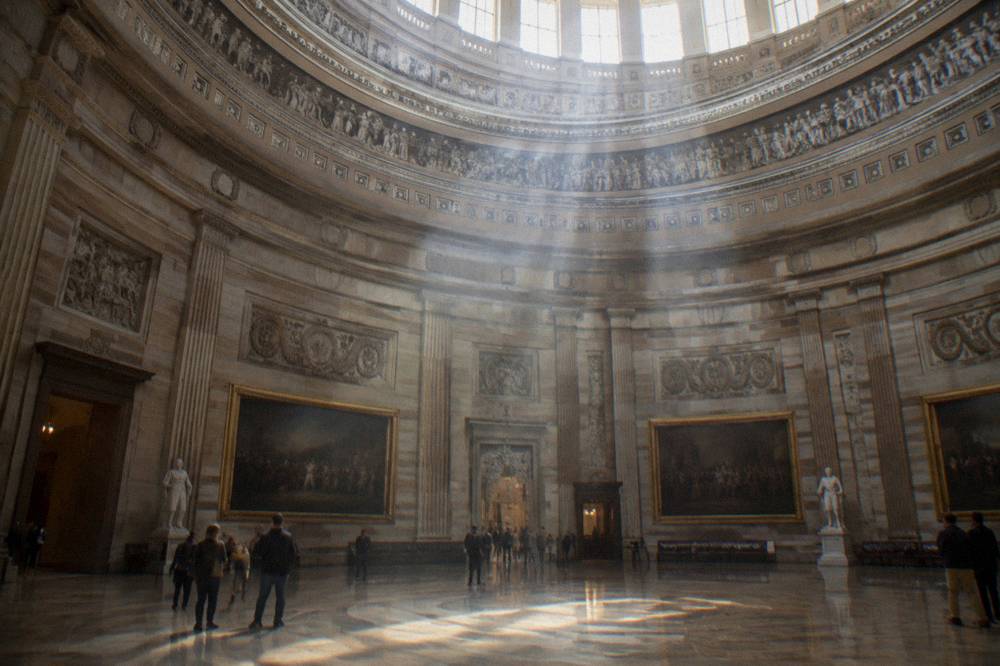
What you actually see on the tour is the working heart of the legislative branch. The Rotunda's canopy fresco, the Brumidi corridors, and National Statuary Hall's collection of state-donated statues are the headline items, and the Crypt one level down holds the empty tomb intended for George Washington. If Congress is in session, the Gallery passes that let you watch from the visitor galleries are arranged separately through your representative's or senator's office, and those are free too, though they are a different reservation from the tour.
One practical note: security at the Visitor Center is airport-style, with the usual prohibited-items list, and lines at the entrance build by mid-morning. An early timed slot means you walk straight into the screening line before it backs up. The building closes to visitors earlier than the museums do, so the Capitol is the one building of the three that genuinely rewards a morning start.
The Capitol's east plaza is also where the government-building cluster meets the National Mall proper. Walk out of the Visitor Center, cross First Street SE, and the Library of Congress is in front of you. Walk the other direction and the Mall's monument corridor begins, the same ground covered by the free, pay-what-you-want walking tours that operate on the Mall. The daytime monuments walk run by guide Lisa, rated 4.4 across 324 GuruWalk reviews, meets at the World War II Memorial and covers the West Mall corridor over about two hours, which pairs naturally with a morning Capitol tour: buildings in the morning, monuments in the afternoon.
The pairing works in the other direction too. If your Capitol slot is late in the day, the monuments walk fills the morning instead. Either order keeps the whole day free, since both the buildings and the walks cost nothing up front, and the walks operate on a pay-what-you-want basis where you tip the guide at the end.
Library Of Congress: Free Entry, Free Tours, No Ticket
The Library of Congress is the easiest of the three: free entry, no timed pass, and free guided tours that you simply join on site, which makes it the one building on this itinerary with no planning step at all. The Jefferson Building, the ornate structure with the Great Hall and its stained-glass dome, admits walk-in visitors during opening hours with no reservation of any kind. Free public tours of the building leave from the ground-floor information desk at set times, and the exhibition galleries, including a display on the early Americas and the rough draft of the Declaration of Independence in Jefferson's own hand, are self-guided and free.
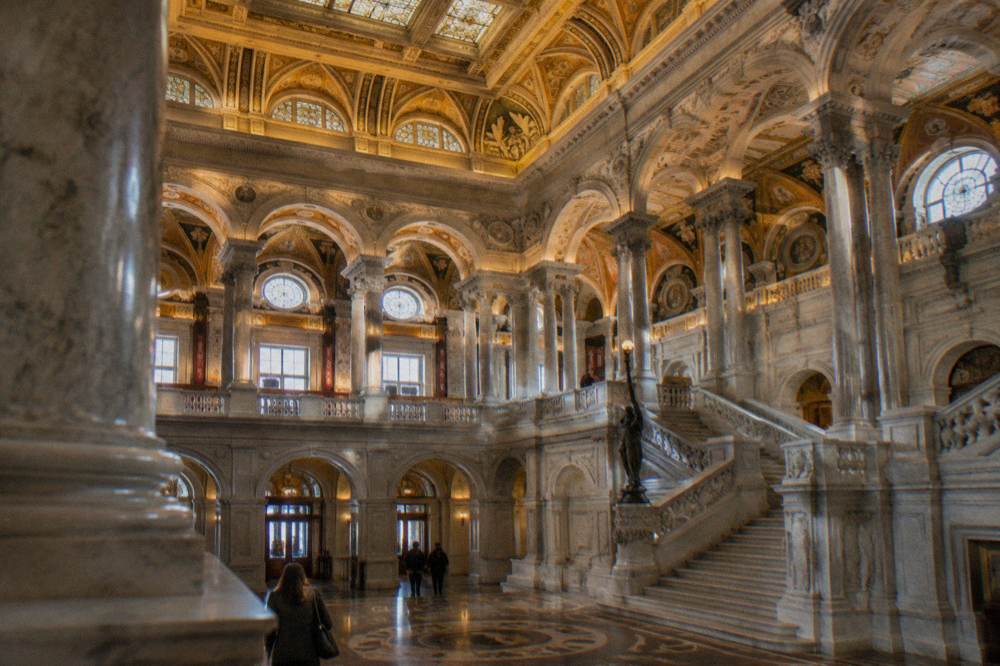
The Great Hall alone justifies the visit. Gilded arches, the marble grand staircase, the painted ceiling and the Gutenberg Bible on permanent display make it the most visually extravagant free interior in a city full of them. The official Library of Congress visit page at loc.gov/visit carries current hours and tour times, and the building closes earlier than most Mall museums, so an afternoon visit needs a start before mid-afternoon.
There is a practical underground connection between the Capitol and the Library that most first-time visitors miss. A tunnel links the Capitol Visitor Center to the Jefferson Building, so in bad weather or high-security days you can move between the two without going outside or re-clearing screening. It is a small thing, but on a hot DC afternoon it saves a real walk, and it means a Capitol tour slot and a Library visit can run back-to-back with almost no transit time.
The Library is also the quietest of the three. The Archives draws school groups and the Capitol draws tour groups, but the Jefferson Building's galleries absorb crowds well. If you want a calm hour in the middle of a packed free day, schedule it here.
National Archives Museum: The Founding Documents, Free
Yes, the National Archives Museum is completely free to visit, and it houses the original Declaration of Independence, Constitution, and Bill of Rights in its Rotunda. No reservation or timed ticket is required for general entry, but short operating hours and long midday lines mean your arrival time matters, so plan to come early or late in the day. The Rotunda for the Charters of Freedom is the single most concentrated display of founding documents anywhere, and the public viewing gallery around it is open to all comers during opening hours. The museum is small, the hours are the shortest of the three buildings, and the line outside is a genuine factor: mid-morning to early afternoon sees the longest waits, while the first hour after opening moves quickly.
Beyond the Rotunda, the museum's Public Vaults gallery extends the story with interactive displays drawn from the Archives' holdings, and the David M. Rubenstein Gallery houses an original Magna Carta, one of only a handful of surviving copies in existence. The Archives' own site at archives.gov lists current hours and any special notices, and checking them matters here more than at the other two buildings, because the Archives closes earliest and has occasionally reduced hours around federal holidays.
Photography is not permitted in the Rotunda, which is the one rule that catches visitors off guard. The documents themselves are faded to the edge of legibility after two and a half centuries, and the dim lighting that preserves them is the reason. Plan a slow lap of the gallery rather than a quick photo stop, and the visit lands better.
The Archives sits on Constitution Avenue at the head of the monument corridor. Step out of its front doors and you are looking down the Mall toward the Washington Monument, with the Smithsonian castle museums to your left and the memorial corridor to your west. That position makes it the natural hinge between the government-building morning and a monuments afternoon.
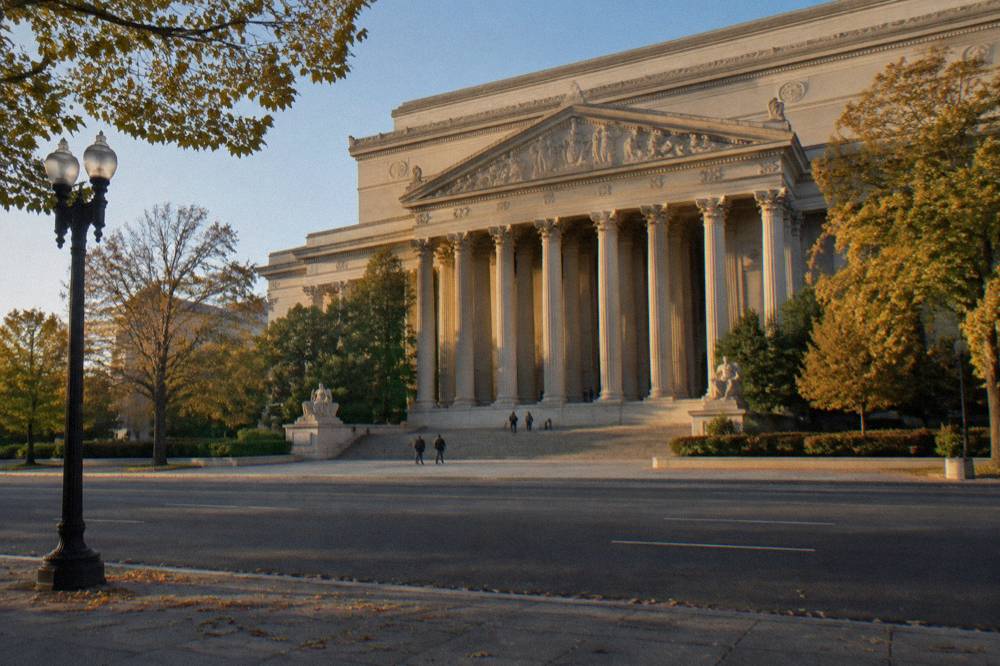
Stepping out of the Archives puts you onto the Mall's westward corridor, and that ground is exactly what the free walking tours on this site cover. The daytime Monuments Walk, a free GuruWalk listing run by guide Lisa, covers the memorial corridor from its World War II Memorial meeting point, and the Blue Umbrella Tours Mall walk, rated 8.7 out of 10 across 143 freetour.com reviews, covers the same ground in a longer two-and-a-half-hour format from a different operator. Both are free to join with a tip at the end, and both start within a short walk of the Archives' front steps.
Reservation Rules At A Glance
Each of the three buildings follows its own reservation rule, and the tables below give you the short version of all of them. Alongside each rule, the sequencing logic is spelled out so you can see exactly how bookings are handled, building by building, without having to dig through the full policy text for each one. The pattern to remember is that only the Capitol's guided tour needs a timed reservation, the Library needs nothing, and the Archives needs nothing but rewards an early arrival. Everything in the tables is free; the only money that can enter the picture is a booking-channel service fee on an advance Capitol reservation, and even that is avoidable by picking up a same-day pass in person.
| Building | Admission | Reservation needed | Best arrival window |
|---|---|---|---|
| US Capitol Visitor Center | Free | Timed slot for the guided tour; galleries walk-in | Early morning, before 10 a.m. |
| Library of Congress (Jefferson Building) | Free | None; free tours join on site | Any time before late afternoon |
| National Archives Museum | Free | None for general entry | First hour after opening |
A second table helps with the sequencing question, because the three buildings' opening hours do not overlap perfectly. The Archives closes earliest, the Library closes mid-afternoon, and the Capitol runs tours into the afternoon. Working backward from the earliest closing time is the whole trick to a three-building day.
| Order | Stop | Why this slot |
|---|---|---|
| 1 | Capitol tour | Morning slots avoid screening lines; building closes to tours mid-afternoon |
| 2 | Library of Congress via the tunnel | Runs directly off the Capitol; no ticket, no line |
| 3 | National Archives | Short walk west; arrive before the midday line builds |
The third table widens the frame to the other free federal stops in the same neighborhood, covered in more detail in the next section. Their reservation rules differ sharply from the big three's, and the White House in particular cannot be added to a same-day plan at all.
| Nearby stop | Admission | How access works |
|---|---|---|
| Supreme Court | Free | Open exhibitions on non-session days; free lectures when the Court sits |
| Bureau of Engraving and Printing | Free | Timed ticket for the printing-floor tour in peak season |
| White House tour | Free | Request through a member of Congress, weeks in advance |
Other Free Government Tours Within Walking Distance
Yes, several other free government tours sit within walking distance of the big three, and the same neighborhood holds more free federal access points beyond the Capitol, Library of Congress and National Archives. Two of them can even be added to the same day without much effort. The Supreme Court, directly across the plaza from the Capitol, offers free visitor lectures and courtroom tours on days the Court is not sitting. The Bureau of Engraving and Printing, a ten-minute walk southwest, runs free tours of the money-printing floors, though it requires a timed ticket in peak season. And the White House's free tour, the most conditional free offer in the city, must be requested through a member of Congress, typically weeks in advance, so it belongs on a planning list rather than a same-day itinerary.
The Bureau of Engraving and Printing deserves its own sentence because it is the least known of the group. Watching sheets of currency move through the presses is a genuinely strange free spectacle, and the building sits on 14th Street between the Archives and the Lincoln Memorial, right on the walking route west. The Supreme Court, meanwhile, is the easiest add-on in the city: its ground-floor exhibitions are open on non-session days with no ticket, and it shares the Capitol's plaza, so it costs you about ten minutes of walking.
For a fuller treatment of the memorial corridor that begins where these buildings end, the guide to free monuments on the National Mall covers every memorial west of the Archives, and the guide to free museums in Washington DC picks up the Smithsonian cluster you pass on the way. If you are planning a longer stay, free things to do in Washington DC this weekend tracks the recurring free events, including the Kennedy Center's nightly Millennium Stage performances, which pair well with an evening after a government-building day.
A Sample Free Day: Buildings And Monuments
A realistic free day pairs the three buildings in the morning with the Mall in the afternoon, and the order matters more than the individual stops. Start with the buildings while your energy is high, then let the afternoon unfold along the Mall, where the spacing between monuments does half the work of the itinerary for you. Start with a 9 a.m. Capitol tour slot, cross to the Library of Congress through the tunnel by 10:30, and reach the Archives before noon, when its line is still short. Lunch can be a picnic on the Mall's grass, since the food courts near the buildings are the one genuinely expensive part of this itinerary. By early afternoon you are standing at the head of the monument corridor with the whole west Mall in front of you.
That is the moment to join a free walking tour. The daytime Monuments Walk covers the World War II Memorial, the Lincoln Memorial and the corridor between them in about two hours, and its World War II Memorial meeting point is a fifteen-minute walk from the Archives' front steps. If the afternoon has slipped and the daylight is going, the evening alternative exists instead: the Monuments By Moonlight walk, a free GuruWalk listing also run by Lisa, rated 4.26 across 65 GuruWalk reviews, meets at the Albert Einstein Statue and covers the lit-up memorial corridor in an hour and a half.
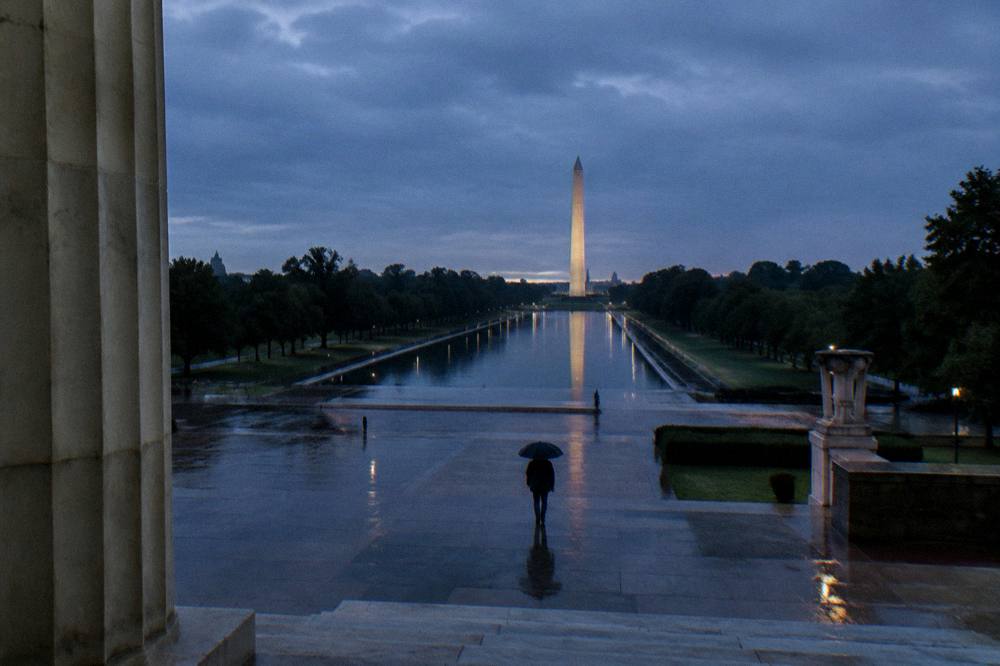
The moonlight version changes the character of the same ground entirely. The Lincoln Memorial at night, with the Gettysburg Address lit on its interior walls and the Reflecting Pool dark in front of it, draws a different crowd than the daytime version, and the shorter runtime makes it an easy fit after a full museum day. Running the government buildings in the morning and the moonlight walk in the evening leaves the whole middle of the day free for the Smithsonian museums in between.
A note on season, because it changes the plan. Late March brings the cherry blossom peak, which hit March 26 in the most recent season per the National Park Service's Bloom Watch, and the Tidal Basin crowds at that time of year push every nearby attraction's lines outward. Summer brings heat that argues for the moonlight walk over the midday one. Fall and spring weekdays are the sweet spot for the three-building day, when the Archives line barely forms and Capitol slots are easy to book a few days out.
Common Questions About Free Government Tours In Washington DC
Is the United States Capitol Visitor Center free?
Yes. The Visitor Center and its exhibition galleries are free and open to the public, and the guided tour of the Capitol itself is also free, though it requires a timed reservation booked in advance or picked up same-day at the visitor desks.
Do you need a ticket for the Library of Congress?
No. The Jefferson Building admits walk-in visitors with no reservation, and its free guided tours are joined in person at scheduled times rather than booked ahead.
Is the National Archives Museum free to visit?
Yes, general entry is free with no ticket. The museum's hours are shorter than the other buildings' and the midday line is longest, so arriving near opening time saves the wait.
Can you see the Declaration of Independence for free?
Yes. The original Declaration of Independence, Constitution and Bill of Rights are all on free public display in the National Archives Museum's Rotunda for the Charters of Freedom.
Can you tour all three buildings in one day?
Yes, comfortably. The Capitol and Library of Congress are connected by an underground tunnel, and the Archives is a fifteen-minute walk west. A morning Capitol slot, a late-morning Library visit and a pre-noon Archives arrival is the standard sequence.
Are the free walking tours of the Mall actually free?
The walks listed on this site are free to join and operate on a pay-what-you-want basis: you tip the guide at the end what you feel the walk was worth. There is no fixed charge and no booking fee.